Rwanda’s capital market has renewed its drive to encourage young people to save and invest through the capital market, as part of efforts to build a stronger investment culture and widen access to long-term finance.
The message was delivered during the 2026 Capital Markets Youth Forum, a national campaign that attracted more than 1,100 contestants and reached over 6,000 students through roadshows across all provinces.
The forum was organised by the Capital Markets Authority, Rwanda National Investment Trust, Rwanda Stock Exchange and Luxembourg Development Cooperation Agency. It focused on helping young people understand savings, investment, shares, bonds and collective investment schemes.
The Chief Executive Officer of the Capital Markets Authority, Romeo Ngarambe said the capital market should not be viewed as a space reserved for large companies, wealthy individuals or financial institutions. He noted that “Through this programme, we seek to build a stronger culture of saving and investment among youth. We want young people to understand that the capital market is not reserved for a few institutions or large investors.”
For young people, the capital market offers practical entry points. Through shares, they can own part of listed companies. Through bonds, they can lend to the government or companies and earn returns. Through collective investment schemes, they can pool modest amounts with other investors and benefit from professional fund management.
Alodie Iradukunda, a Member of the East African Legislative Assembly, urged young people to look beyond saving alone and put money into productive assets. She said that “Saving alone is no longer enough.”
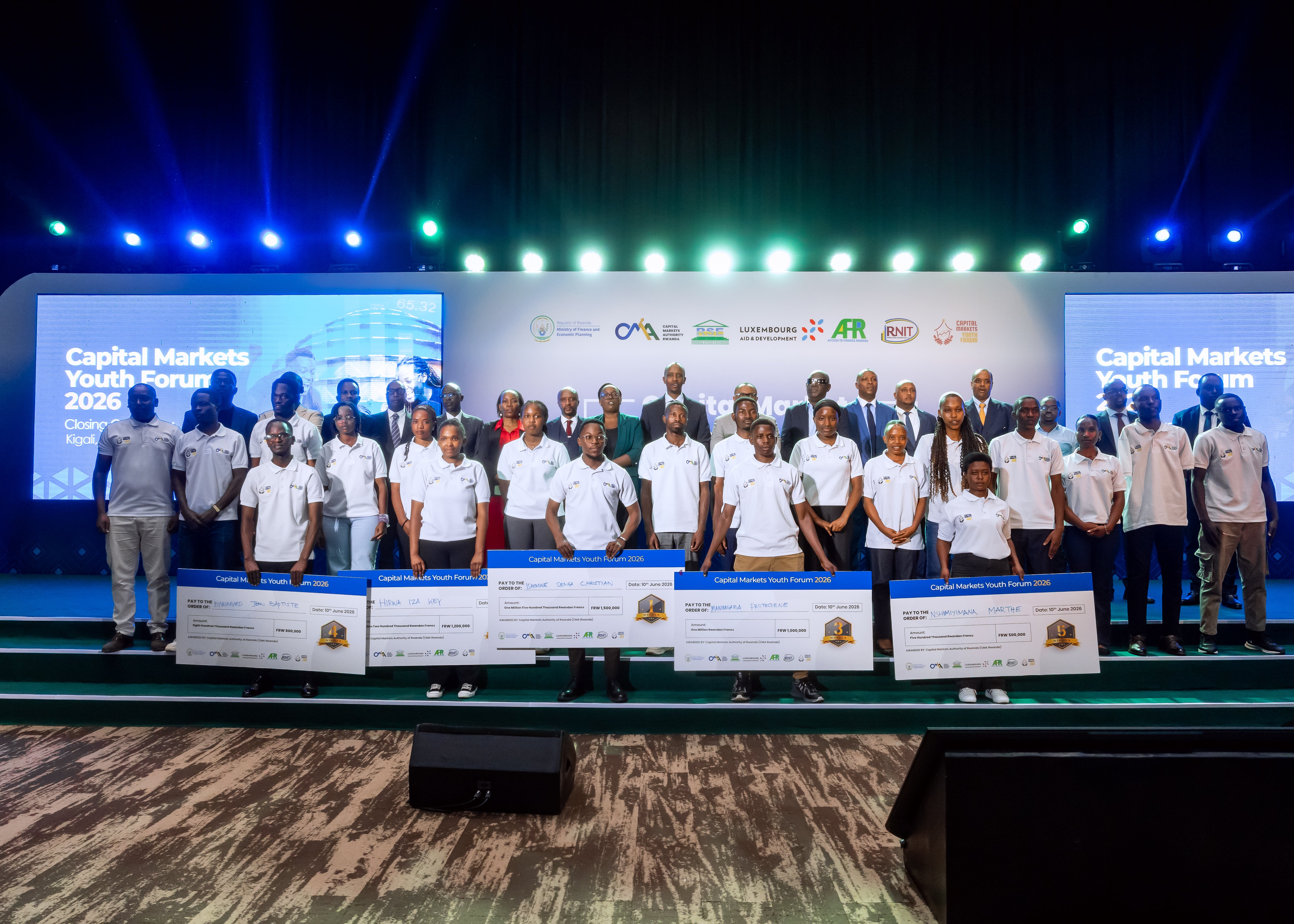
The Capital Markets University Challenge held as part of the Capital Markets Youth Forum, concluded with 5 winners from 1,100 contestants. The winners received prizes in shares, bonds and Collective Investment Schemes which provide practical exposure to capital market products & long-term investment.
Christian Ishimwe Senga took first place and received Frw 1.5 million worth of shares, bonds and Collective Investment Schemes. Iza Key Hirwa came second with Frw 1.2 million, while Protegene Maniragaba finished third with Frw 1 million. Jean Baptiste Byiringiro came fourth with Frw 800,000, while Marthe Nshimyimana came fifth with Frw 500,000.